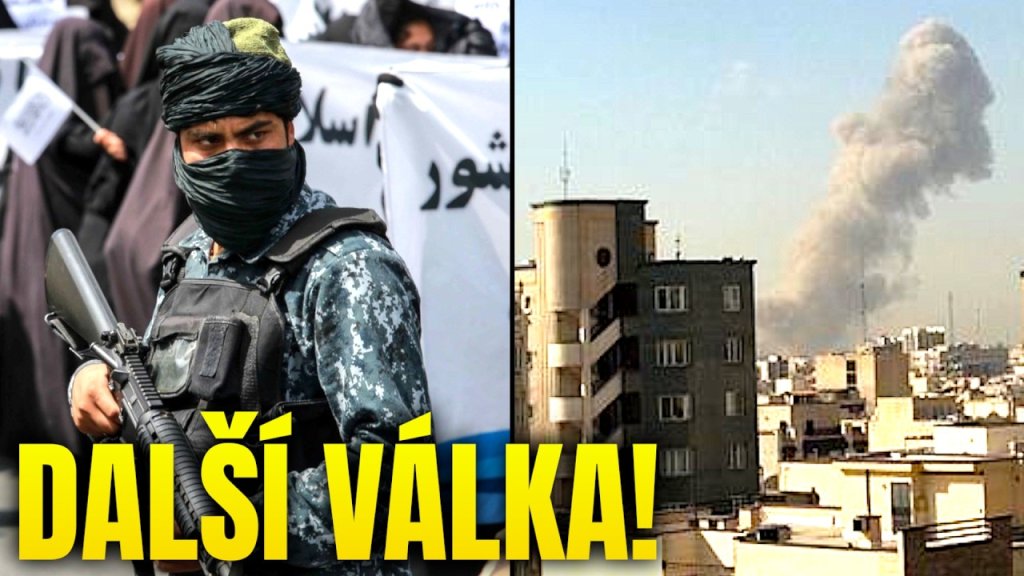

Pakistan vs. Afghanistan: bombing, the Durand Line and the return of "open war"
Night raids on Kabul and Kandahar
CzechCloud in its special stream describes the violent escalation between Pakistan and Afghanistan that occurred on the night of Thursday to Friday.
According to available information:
- The Pakistani Air Force launched airstrikes on targets in Kabul, Kandahar and Paktika province.
- Headquarters, ammunition depots and other key Afghan Taliban positions were targeted.
- Pakistan describes the operation as retaliation for cross-border attacks and for the Afghan regime's support for the Pakistani Taliban (TTP).
News websites (e.g. CT24, CNN Prima NEWS, Seznam Zpravy) consistently report that:
- Pakistan reports strikes against "militants" and military targets.
- The Afghan side speaks of high civilian casualties, including women and children.
- Casualty figures vary dramatically and independent verification is virtually impossible at this time.
CzechCloud and its guests point to this as a classic problem in such conflicts: both sides immediately launch their own propaganda and the numbers are necessarily suspect.
From terrorist attacks to "open war"
According to the summary in the stream and according to foreign sources, the current escalation is unfolding as follows:
- Pakistan has long accused the Afghan Taliban of tolerating or supporting a Pakistani offshoot of the Taliban (TTP) on its territory that attacks Pakistani security forces.
- A series of terrorist attacks in Pakistan was followed by Pakistani air strikes on Taliban "security points" and posts in Afghanistan.
- The Afghan Taliban responded with attacks on border posts and announced the launch of a major offensive against Pakistan along the disputed border.
- Pakistan subsequently stepped up airstrikes and shelling again.
According to CT24 and Seznam News articles, Pakistan's Defence Minister Khawaja Asif said:
- Pakistan has "run out of patience".
- The country is in "open war" with the Afghan Taliban.
In the stream, it is said that such statements are also part of a political and propaganda game - a show of force towards one's own population and intimidation of the opponent. Yet this is a significant shift in rhetoric: they are already talking directly about a two-state war.
The Durand Line: 2,600 kilometres of disputed border
CzechCloud and guests stop at the concept of the Durand (Durand) Line, which is central to the current clashes.
Basic Facts:
- It is a roughly 2,600 km long border between Afghanistan and Pakistan.
- It was established during British colonial rule as the border between what was then British India and Afghanistan.
- Pakistan recognizes it as its official border.
- Afghanistan has long not recognised it and considers part of the territory to be its own.
The stream says:
- Virtually the entire border between Pakistan and Afghanistan today is formed by this line.
- The contentiousness of the border is also related to the historical division of Pashtun territories and British colonial policy.
- Commentators have noted with exaggeration that 'this is another war that is the fault of the British', referring to the legacy of colonial border demarcation.
Today, the Durand Line is not only a geographical but also a political and symbolic focal point of conflict. It is along this line that land clashes and strikes on border posts take place.
Propaganda and conflicting casualty figures
One of the main themes that CzechCloud and its guests highlight is the extreme discrepancy in casualty figures:
- Pakistani sources speak of tens to hundreds of Taliban fighters killed, emphasizing that they are targeting militants and military targets exclusively.
- The Afghan Taliban Ministry of Defence, on the other hand, claims that the Pakistani strikes are killing mainly civilians and only a minority are soldiers.
- The specific figures vary considerably and it is not possible to verify them in the context of frontline propaganda and limited journalistic access to the field.
According to CNN Prima NEWS and other media:
- In some cases, there is talk of dozens of civilian casualties, including women and children.
- Pakistan stresses that the Afghan regime is not doing enough to fight terrorist groups, and says it has no choice but to intervene on its territory.
The stream sounds a skeptical note:
- "It's still propaganda from both sides."
- Real casualties are likely to be higher on the Afghan side because Pakistan uses airpower and heavy artillery, while the Afghan Taliban rely mainly on guerrilla tactics.
Asymmetry of forces: army of Pakistan vs. Taliban
CzechCloud also discusses with guests the simple question: **who has the military upper hand?
The conclusion is clear:
- Pakistan has a vastly superior military that has been preparing for a possible conflict with India for decades.
- It has:
- a modern air force,
- heavy artillery,
- a large ground army,
- and a nuclear arsenal (in relation to India).
- The Afghan Taliban have mostly lightly armed units, relying on gerrymandering, knowledge of the terrain, and dispersed structures.
In the stream, there is a parallel to the "David vs. Goliath" contest - with the implication that "Goliath" (Pakistan) is equipped for conventional war with a major regional power (India), while the Taliban operates as a typical insurgency.
At the same time, however, the historical lesson, which is repeated in the video, is valid:
- The British, the Soviet Union, and the United States all "cut their teeth" on Afghan territory.
- The long-term occupation and 'clearing' of territory of insurgents is extremely difficult and usually not successful.
Guests thus question the realism of the goals if Pakistan really wanted to "eradicate the Taliban" or even occupy larger parts of Afghanistan.
Unclear future: operational objectives and wider implications
According to the quoted statements, the Pakistani leadership states that it will continue operations "until the desired objective is achieved ". However, what exactly they mean by this is not clearly defined.
Possible interpretations discussed in the stream:
- To coerce the Afghan Taliban:
- Reduce or end support for the Pakistani branch of the Taliban (TTP),
- accept certain security arrangements along the Durand Line.
- Demonstrate to domestic audiences that the military is actively responding to attacks and protecting the border.
CzechCloud and its guests are restrained in their estimates:
- They assume that the two sides will "slap each other around" for a while, as the stream puts it, and then they can move on to negotiations.
- At the same time, they warn that the Afghan Taliban may use the conflict to maintain its own legitimacy - a war movement without an enemy loses some of its internal meaning.
So far there are no clear statements from India, which Pakistan mentions in its rhetoric (Afghanistan is described as "India's extended arm"). Guests liken this to rhetoric where Pakistan frames virtually any adversary as a tool of India.
Final Summary
In a special stream, CzechCloud captures the beginning of a new open phase in the long-simmering dispute between Pakistan and Afghanistan:
- Pakistan is launching air and ground strikes deep into Afghan territory, including Kabul and Kandahar.
- The Afghan Taliban respond with cross-border attacks and declare an offensive along the Durand Line.
- Both sides report high enemy casualties, but the figures are unverifiable and clearly influenced by propaganda.
- Pakistan has clear military superiority, but the experience of history shows that 'winning' in Afghanistan is very different from winning a few battles.
How the conflict will develop further remains open. All that is certain is that another war on the fragile border between two nuclear powers (Pakistan-India) and an unstable Afghanistan brings another wave of uncertainty to the region - and more suffering to civilians on both sides of the Durand Line, about which there are now only sketchy and contradictory reports.
Comments
No comments yet. Be the first to join the discussion.