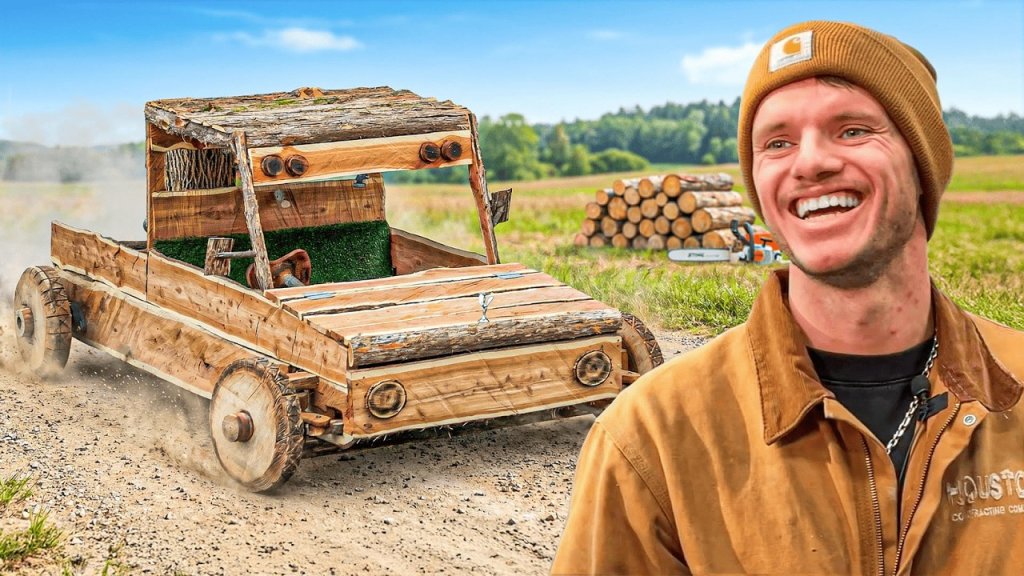

Inside WhistlinDiesel’s Wild Wooden Car Challenge (Part 1)
The Premise: Build a Drivable Wooden Car From Forest Scraps
In “The WhistlinDiesel Wooden Car Challenge (Part 1)”, creator Cody Detwiler (better known as WhistlinDiesel) sets up a multi‑day fabrication contest that leans hard into his trademark mix of mechanical ingenuity and deliberate chaos.
The core rule is simple but brutal:
- Every team must build a running car using only materials found in the woods for the structure.
- All teams get the same engine: a Yamaha Palinator 350 (a small ATV‑style powerplant).
- Non‑wood components are limited to bolts, nuts, screws and the drive sprocket.
- No pre‑cut lumber or off‑the‑shelf metal parts are allowed; violations risk full disqualification—and Cody jokes that the offending car would be cut to pieces.
The result is four radically different wooden vehicles, all attempting to meet a loose definition of a “car”: two seats, a maximum footprint of 4 feet by 8 feet, and functional steering and propulsion. There’s a $5,000 prize on the line for the best‑performing build and the best overall design.
The Teams, Relationships, and Running Jokes
Cody divides the challenge into four teams of two, leaning into family pairings and on‑camera chemistry:
-
Brady & Jeff
- Brady is a cameraman for the channel; Jeff is his dad.
- Cody immediately turns their intro into a bit, joking that Jeff found Brady under a bridge at five years old “diagnosed with a thousand diseases” and that people thought he was biologically female when discovered—obvious mock backstory for comedic effect.
-
Tyler & Doug
- Tyler is described as the channel’s "master fabricator"; Doug is his dad.
- Cody teases that Tyler was "normal" growing up, trailing into laughter.
-
Danny & Rick
- Danny works as a camera technician; Rick is his father.
- They’re quickly suspected of pushing the rules on wood sourcing.
-
Cody & Grandpa Bob
- Cody pairs with his grandfather Bob, whose vehicles he says he’s “destroyed” in past projects.
- Bob lends old‑school mechanical sense and helps devise steering and general layout before leaving late in the build due to other obligations.
Cody notes his own dad is absent, joking that he’s “piloting a 747 across the Middle East” and then a fighter jet, a clear bit of exaggerated humor to explain why he isn’t in the challenge.
Throughout the build, much of the video’s entertainment comes from that dynamic: fathers and grandfathers ribbing each other, Cody switching allegiances between teams as a “fan,” and frequent mock accusations of cheating or sabotage.
Sourcing Wood and the Wheel Problem
Logging chaos and early setbacks
The first major hurdle is sourcing usable trees for both frames and wheels. Teams head into the woods with chainsaws expecting this to be the “easy” part. It quickly isn’t.
Key moments:
- One truck gets badly stuck in a creek crossing because it’s only two‑wheel drive, burning fuel and time just trying to cut down and haul a single tree.
- A crane has to be brought in to rescue the buried truck. Cody, frustrated, half‑jokes about giving up and going to buy a brand‑new truck from a dealership.
- Some trees prove rotten at the root, falling over unexpectedly and forcing teams to drag entire trunks back instead of getting clean sections.
The all‑wood wheel dilemma
Everyone eventually realizes that wooden wheels are the hardest technical problem:
- To get usable, round-ish wheels, they either need to cut discs out of massive logs or improvise another solution.
- Cody briefly entertains the idea of cutting round discs from plywood, but rejects it as less “natural” than using full log rounds.
- The teams even consider buying a huge log on Facebook Marketplace so they can all share it for wheels—still technically tree material, but arguably skirting the spirit of “found in the woods.”
Tyler and Doug eventually find what they call a “hidden gem” log on the property: a very straight, solid trunk they’ll use heavily for chassis and drivetrain components. Another team debates safety around trees with hollow cores, noting they’re dangerous to fell.
Meanwhile, Cody voices his frustration: he hates woodworking, insists that "wood’s for losers" (then apologizes to the woodworkers present), and laments that they didn’t choose a steel car challenge instead.
Four Very Different Wooden Car Concepts
Though all are constrained by the same engine and basic rules, each team pursues a wildly different design.
Brady & Jeff: A compact, feature‑packed “car”
Brady and Jeff focus on a more conventional small car:
- They build up a framed structure out of relatively refined logs and milled lumber they’ve cut themselves.
- Their car ends up with cup holders, marked seating, and even Montana license tags for flair.
- Steering, throttle and clutch are integrated into a relatively straightforward layout: wood frame rails, wooden suspension/spring components, and a chain drive.
In early runs, their car actually moves—but almost immediately:
- A wheel “blows” (Cody calls it a “blown log”),
- The motor mount area is damaged badly enough that Cody describes it as a blown motor in under 30 seconds.
It becomes clear that none of these builds will be “high performance,” and the joke shifts to everyone being equally slow and fragile.
Danny & Rick: Overlength, overcomplicated, and literally on fire
Danny and his dad go maximalist:
- Their car is extraordinarily long—Cody calls it “60 feet long” in obvious exaggeration, and points out that the booths they worked in are only about 15 feet deep.
- They add a central suspension arrangement and an elaborate drivetrain, including aggressive, spiked‑looking rear drive elements that remind Cody of extreme hill‑climb dirt bike tires.
The most theatrical additions:
- A flammable showpiece system under the car:
- Bottles with fuel or similar flammables,
- Ignition via a lighter or torch,
- Designed so the car can carry a visible flame and then be blasted with additional spray for dramatic effect.
- This goes predictably wrong during demonstration, as a spray coats the concrete and ignites. The team scrambles for water and hastily puts it out amid jokes about having essentially painted the floor with fire.
Cody repeatedly questions how their steering actually works and whether the flame system has any competitive value beyond spectacle, especially for the planned “push of war” event.
Tyler & Doug: “Trunk” – the tractor‑like wooden sawmill
Tyler and Doug’s entry, nicknamed “Trunk”, leans into Tyler’s fabrication skill and a tractor aesthetic:
- The chassis is essentially a solid tree trunk with seating carved into it.
- The rear drive is built around a massive log wheel that Cody compares to an ancient sawmill flywheel.
- A metal sprocket is mounted on a severely unround wooden drum, with rows of nails hammered in around it to keep the chain from slipping off.
- The geometry and gearing are aimed at torque and traction rather than speed; there’s a running joke about what happens if it ever reaches sixth gear.
During the reveal, they discover a massive spider living inside the car:
- Cody calls it the biggest spider he has ever seen.
- The team carefully transfers it to a wooden cube and releases it, while everyone jokes about wildlife taking up residence in the build and what would happen if it crawled onto a driver mid‑run.
Cody’s grandpa Bob, asked to compare the partially finished cars, calls Tyler’s build a “Cadillac on wheels,” noting how different it is from the others. He also suggests that in terms of speed, either Tyler’s or Cody’s own car might be quickest because they’re relatively light.
Cody & Grandpa Bob: An almost “real” wooden sports car
Cody’s own car is the most car‑like in shape and seating:
- The body is sculpted with clear attention to aesthetics; Cody jokes they received a cease and desist letter from Bugatti because the design was too close to one of their models—obvious parody, but it captures the ambition of his build.
- The fuel tank is a hollowed‑out log he manually carved, which he proudly shows off.
- Seats are integrated into the wooden body for a genuinely comfortable driving position; multiple people remark on how surprisingly nice it is to sit in.
Technically:
- The front end uses carved wooden steering arms and linkages, which Cody stresses are made of stronger oak rather than softer cedar. He calls them the “key to winning” and insists they won’t break.
- At one point, a prototype lever‑based steering idea would have required the driver to lift the front of the car to initiate a turn so it could snap back to center—this is eventually replaced with a more conventional layout.
- Cody’s crew experiments with elaborate, F1‑style right‑hand‑drive steering setups and ends up accidentally building a system that turns the wheels the opposite direction of the wheel input. After Cody notices, they call it a lesson in checking your work.
By the end of the build days, Cody’s car is running but fragile:
- It manages a short run out of the shop before the rear axle shears.
- The fuel tank cover falls off immediately because it was never fully fastened.
Despite that, it’s one of the few cars that moves under its own power at all, positioning it well for improvements in the next part.
Rules, Cheating Scares, and Ongoing Banter
Because the core rule is “only materials found in the woods,” the video is full of rule‑lawyering and gray areas.
Pre‑cut lumber and imported wood
At one point, a judge confronts Danny’s team:
- Danny’s dad is spotted carrying pre‑cut lumber, which violates what Cody jokingly calls “code 62C of the car building code.”
- Cody warns that if that wood is used in the vehicle, the team could be disqualified and their car chopped apart.
Danny’s group also admits they imported bamboo from off‑site after Cody allowed it as a material, arguing it was technically wood but not available on the property. This opens the door to debates about sourcing logs through Marketplace instead of cutting everything on‑site.
Metal, welders, and “natural materials”
Metal use is supposed to be strictly limited to hardware and the drive sprocket. That doesn’t stop borderline decisions:
- Cody walks in on one team welding and asks pointedly, “At what point did the welder get involved in the wooden build?”
- They insist they’re only using metal for allowed hardware and sprockets, though the amount of electrical arcing and metallic sound makes Cody suspicious.
- He warns that any metal beyond permitted fasteners and the single sprocket could lead to disqualification.
Meanwhile, Cody’s own team briefly uses a powered saw rig to try to “self‑feeding” cut wood with the chain, which he calls one of the smartest things he’s ever done—right before it fails.
Friendly trash talk and shifting allegiances
The entire challenge is laced with friendly rivalry:
- Cody alternates between claiming he’s “team Brady” and later saying he’s rooting for Tyler, only to be accused of switching sides constantly to avoid sharing the prize money.
- He mocks other builds as houses, blocks, cubes, and “anvils of wood,” while they counter that his is just three boards nailed together until late in the process.
- There are jokes about “sandbagging” their progress, misinterpreted for a moment as a racially charged term, which leads to some back‑and‑forth about “victim mentality.”
- When one team’s wheel splits during testing, Cody calls out that they now have zero functioning wheels and celebrates the mishap as a competitive advantage.
By the end of several days, everyone is exhausted, talking about 4 a.m. call times and living on energy drinks, yet still leaning heavily into the humor.
Day‑By‑Day Progress and First Real Tests
Day 1–2: Designs and rough structures
- Early on, nobody has a clear concept. Cody admits his team has “nothing at all,” while others claim to be “winging it” or only just forming a game plan.
- One team considers a dugout canoe style body to keep things “naturesque.”
- Tyler sketches out a Polaris Slingshot‑like three‑wheeler: a driven rear wheel and two front steering wheels, plus carved bucket seats from a downed tree.
By the end of day two:
- Most teams have engines roughly positioned and some form of steering concept mocked up.
- Cody’s group has an engine mounted and clutch and throttle partially functional, but no completed wheels. Forklift wheels are jokingly floated as a forbidden shortcut.
Day 3–4: Wheels, sprockets, and fine‑tuning
The third and fourth days revolve around making wooden wheels work at all:
- Tyler and Doug spend a huge amount of time turning log sections into rough discs, shaping three wheels first (they’re doing a three‑wheeler) and then fine‑tuning the drive axle.
- Cracking becomes a problem: the rounds start to split as they dry, forcing them to reinforce and re‑shape the wheels to reduce wobble.
Some key technical patches:
- On Tyler’s car, rows of nails are used as de facto chain guides around the sprocket.
- Cody’s team invents a wooden "dyno" stand to spin the rear wheel and align the sprocket, because simply jacking the car up won’t hold the uneven wheels securely.
Cody also has to rebuild his steering system after discovering the reversed input. He and his crew experiment with more traditional wooden linkages that offer normal left‑right behavior.
Final day: Partial runs and universal failures
By the time they stage the first real tests:
- Brady’s car makes it maybe 50 yards before a structural failure in the wheel/motor area leaves it crippled.
- Danny’s long car moves, but the chain shreds or the drive setup fails quickly.
- Cody’s car drives out of the shop but shears its rear axle, and the loosely attached fuel tank cover pops off immediately.
Cody observes that all three cars that tried to run made it only a short distance, and the furthest distance achieved still isn’t impressive. It underscores how limited wood is compared to metal for high‑stress components.
Tyler’s car, heavily built and sawmill‑like, is still being refined. Cody jokingly predicts it will be the best performer once sorted out, while also dreading having to compete against it in events like the hill descent and push of war.
Conclusion: A Wooden Car Concept That’s Half Comedy, Half Engineering
Part 1 of “The WhistlinDiesel Wooden Car Challenge” ends with all four teams showing off creative but fragile machines:
- Brady & Jeff deliver a compact, fully featured vehicle that looks most like a normal small car but proves mechanically delicate.
- Danny & Rick produce the most theatrical build, complete with on‑board flame effects and an oversized footprint, but they struggle to maintain drive reliability.
- Tyler & Doug create “Trunk,” a tractor‑inspired, sawmill‑style machine with serious craftsmanship and mass, drawing admiration from Cody’s grandfather and others.
- Cody & Grandpa Bob build the most car‑like wooden body, complete with carved fuel tank and comfortable cockpit, but face drivetrain failures on the first real outing.
Throughout, Cody Detwiler keeps the focus on the process rather than perfection—the point isn’t to build practical wooden vehicles but to see how far they can push the idea, how many different interpretations a simple rule set allows, and how much personality can be carved into literal tree trunks.
By the end of Part 1, no team has a fully sorted car, setting up Part 2 for repairs, upgrades, and the actual competition challenges that will decide who walks away with the $5,000 prize.
Comments
No comments yet. Be the first to join the discussion.