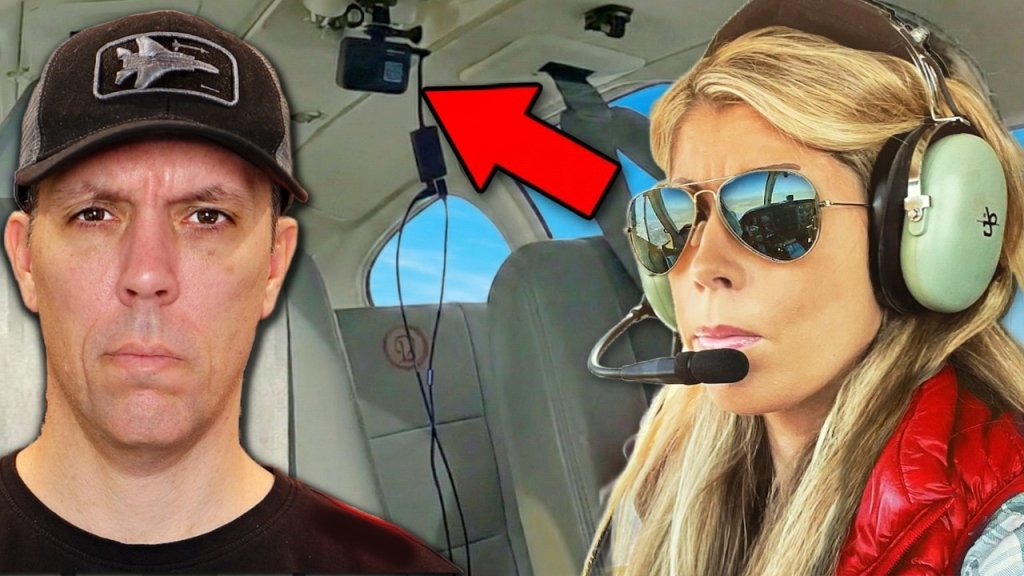

Inside TNFlygirl’s Fatal Flight: What the NTSB Revealed About a YouTube Pilot’s Final Mistake
Jenny Blalock’s Rise as “TNFlygirl”
Hoover’s debrief centers on Jenny Blalock, a 44‑year‑old Tennessee entrepreneur and private pilot known online as TNFlygirl on YouTube and 865flygirl on Instagram. She documented her late‑in‑life aviation journey, training flights, and cross‑country trips, often flying with her Beech Debonair.
Jenny bought a Piper PA‑28 Cherokee in June 2021 and did most of her initial flight training in that airplane. She passed her:
- Private pilot knowledge test in October 2021
- Private pilot checkride in May 2022
By the time she earned her private pilot certificate, the NTSB found she had:
- 193.2 total hours
- 182.6 hours with an instructor
- Only 10.6 hours of solo time
Hoover emphasizes how unusual that profile is: most pilots pass a private checkride with roughly 60–80 hours total and significantly less dual instruction. He argues this should have been an early warning sign that her basic skills and judgment lagged far behind her logbook total.
From Trainer to Complex Aircraft: A Risky Upgrade
Instead of consolidating her skills in the Cherokee after getting her license, Jenny made a rapid jump in aircraft complexity.
- July 2022 (about two months after her checkride): she sold the Piper Cherokee and bought a 1965 Beech 35 Debonair, a high‑performance, complex airplane.
Hoover outlines what made this leap problematic:
- The Debonair has retractable landing gear and a 260‑hp fuel‑injected engine
- Typical cruise: around 160 knots, significantly faster than a Cherokee
- Requires high‑performance and complex endorsements, which the NTSB could not verify in her surviving logbook pages
According to reporting cited in the debrief, Jenny’s decision to move up was partly influenced by a ground incident in the Cherokee: she exited a runway too fast, skidded off a taxiway, and put the airplane into a ditch. The aircraft was repairable, but Hoover contends that an event like this should have prompted a return to fundamentals, not a step into a more demanding platform.
Hoover’s broader concern is systemic: a motivated owner with money can change instructors and keep pushing until someone signs off endorsements, even if underlying weaknesses remain.
Persistent Training Struggles and Overreliance on Automation
As Hoover walks through the NTSB report and surviving videos, a pattern emerges: Jenny’s skill gaps persisted across several core areas.
Basic airmanship and navigation
In one earlier Debonair flight analyzed by Hoover (months before the accident):
- She departed Rockwood Municipal on a clear day, needing only a simple turn to head toward Knoxville Downtown.
- Instead, she turned the wrong direction, flew several 360° orbits near the field for roughly 10 minutes, and appeared fixated on her iPad and autopilot instead of looking outside and navigating visually.
Hoover uses this to underscore his main theme: she often tried to “solve the panel” before flying the airplane.
Radio communication and workload management
The NTSB interviewed instructors who flew with Jenny for her instrument training. One, identified in the report as Aaron, described her as kind and eager but struggling with:
- Radio calls and phraseology
- Managing radios, navigation, and aircraft control at the same time
In one training video Hoover shows, Jenny rehearses a basic call to approach control multiple times before transmitting and still can’t reliably produce it without coaching. Aaron told investigators he sometimes had to take over the radios so she could focus on flying.
Another instructor summarized her situation bluntly:
- She could “fly the airplane” in a narrow sense, but
- She “needed help consistently”
- Without an experienced pilot in the right seat, she would likely lose situational awareness quickly
Hoover argues that you cannot meaningfully say a pilot is capable of safe solo flight if they only function reliably with an instructor constantly backing them up.
Instrument training and missed lessons
In a video titled along the lines of “My IFR training, was this necessary?”, Jenny records an instrument approach while wearing view‑limiting glasses. Hoover highlights several points:
- She drifts right of the runway centerline, and the instructor repeatedly directs her back left and higher.
- Eventually, the instructor takes controls near minimums and transitions them to a visual approach.
- On screen, Jenny adds red circles and text that imply the instructor “set her up” for a bad landing.
Hoover’s critique is not of the instructor’s kindness but of the missed teaching opportunity: in real instrument conditions, arriving that far off at minimums should trigger an immediate go‑around, not an attempt to “salvage” the approach.
He sees Jenny’s framing of the video as further evidence that she sometimes externalized blame instead of confronting how serious her own performance issues were.
The Medication Factor: What the Autopsy Revealed
One of the most significant findings Hoover draws from the NTSB report came not from avionics, but from toxicology.
The autopsy found multiple medications in Jenny’s system, including:
- Alprazolam (Xanax) – used for anxiety/panic disorders; can cause sedation, reduced concentration, and disinhibition
- Trazodone – often prescribed for depression/anxiety; can impair thinking and motor skills
- Buspirone (buperone, as described verbally) – used for anxiety; can cause dizziness
- Another anti‑nausea medication the FAA considers disqualifying for a medical certificate because of serious side effects such as drowsiness, dizziness, and potential heart rhythm issues
Hoover notes that:
- These drugs are on the FAA’s “do not fly” list.
- One would have prevented her from legitimately holding an FAA medical.
- Yet none of them were disclosed on her medical application; she reported only over‑the‑counter allergy medication.
The NTSB stopped short of declaring the medications a direct cause of the crash. Because Jenny’s demonstrated baseline proficiency was already so poor, investigators wrote they could not determine whether additional impairment from drugs changed the outcome.
Hoover suggests that the chronic cognitive and motor‑skill side effects of these medications could help explain:
- Her extreme difficulty mastering basic tasks despite nearly 400 hours total time
- Her frequent confusion with avionics and autopilot systems
- Her inability to consistently manage radios and navigation under load
But he emphasizes that even without a definitive causal link, flying while taking disqualifying medications represents a major breakdown of personal responsibility and regulatory compliance.
The Last Flight: Trim, Autopilot, and a Runaway Situation
Preflight context
On December 7, 2023, Jenny and her 78‑year‑old father James arrived to fly the Debonair to Little Rock for avionics work. According to the NTSB interviews summarized by Hoover:
- Wayne, the flight school’s general manager, saw them at the airport.
- Jenny told him they were waiting for the weather to improve and planned to ferry the airplane to an avionics shop.
- Wayne again warned her she was “way behind the Debonair” and flying more airplane than she was ready for.
- Jenny and her father did not disagree with that assessment.
Despite that candid warning, they departed shortly afterward. Investigators later found:
- No evidence of mechanical failure in the engine, airframe, or autopilot
- Weather was not a significant factor in the accident
- Onboard cameras were either not recording or their data was unrecoverable, so the NTSB relied on ADS‑B flight data and wreckage analysis
Autopilot and trim behavior in cruise
The Debonair was equipped with a Century 2000 autopilot capable of holding altitude but without autotrim. That means:
- The pilot must trim the airplane manually for level flight before engaging the autopilot.
- If airspeed or configuration changes, the trim wheel must be adjusted again by hand.
- When the trim is out of balance, the autopilot flashes “trim up” or “trim down” warnings on an annunciator.
The ADS‑B data for the accident flight showed:
- A target cruise altitude of 6,500 feet, but the airplane meandering around 6,300 feet
- Repeated oscillations of 500 feet or more over about ten minutes: descending to ~6,000, climbing back to ~6,500, and so on
- Significant airspeed swings of 20–30 knots during those altitude changes
Instructors told investigators that Jenny often misunderstood the trim cues:
- She would sometimes trim in the wrong direction, making the autopilot’s trim warnings flash faster.
- In prior similar situations, she became flustered and disconnected the autopilot, then tried to hand‑fly.
Hoover interprets the oscillatory flight path as a running battle between Jenny and the autopilot:
- Instead of trimming in the direction indicated, she may have been repeatedly trimming opposite the needed correction.
- The autopilot then had to command ever larger control inputs to maintain altitude, building up a heavy nose‑down trim condition.
Crucially, throughout this period she made no distress calls or requests for assistance, despite having ample opportunity to simply turn off the automation and hand‑fly a trimmed, level airplane.
Loss of control and fatal dive
At one point ATC pointed out that she was left of course. Jenny replied that she was correcting, but the greater danger lay in the longitudinal axis.
According to the NTSB’s reconstruction, relayed by Hoover:
- The oscillations in altitude and speed grew progressively worse.
- At some point Jenny likely disconnected the autopilot—whether intentionally or as a result of reaching system limits.
- Because of accumulated nose‑down trim, once the autopilot released control, the airplane pitched sharply nose‑down.
- As the Debonair accelerated in the dive, the control forces became too great for her to overcome by pulling back on the yoke.
- The rate of descent exceeded 10,000 feet per minute until impact, killing Jenny and her father instantly.
Hoover characterizes this as a classic automation‑induced loss of control: a pilot who never fully mastered manual trim and autopilot interaction created a configuration that, once unchecked, became aerodynamically unrecoverable.
Lessons Hoover Draws From the Debrief
Hoover frames his video not as a critique aimed at Jenny’s family, but as a safety case study for other pilots. From the NTSB report and the patterns in her training, he distills several key lessons.
1. Being a pilot is a legal and moral responsibility
- Pilots must know and follow medical and medication rules. Taking multiple disqualifying drugs while flying is not a gray area; it’s a clear violation of FAA standards.
- Self‑reporting on the medical exam is an honor system; abusing it undermines both personal and public safety.
2. Flight hours do not equal competence
- Jenny logged around 400 hours total, including 200+ hours in the Debonair, yet still struggled with basic tasks—radio calls, navigation awareness, trim management.
- Hoover stresses that logbook totals can mask serious weaknesses. Endorsements or certificates do not guarantee sound judgment or situational awareness.
3. Listen to instructors and heed red flags
Multiple instructors and the flight school general manager independently warned Jenny that:
- She was behind the airplane
- She was flying a complex, high‑performance aircraft she wasn’t fully ready for
- She consistently had difficulty with radios, navigation, and automation
Hoover’s view is that when several experienced instructors reach similar conclusions, ignoring those warnings can be fatal.
4. Master stick‑and‑rudder before relying on automation
The accident sequence illustrates the danger of using systems you don’t fully understand:
- The autopilot and trim system were simple but unforgiving if misused.
- A pilot who can’t manually establish and hold level flight, then layer automation on top of that, risks becoming a passenger in their own airplane.
Hoover’s closing advice to pilots is stark:
- “Fly the airplane first.” If automation misbehaves or confuses you, turn it off and revert to basics.
- Do not progress to faster, more complex airplanes or advanced ratings until your fundamental airmanship is reliable, repeatable, and verifiably solid.
Summary
In this Pilot Debrief episode, Hoover walks carefully through the NTSB’s final report on the crash that killed YouTube pilot Jenny “TNFlygirl” Blalock and her father. He links the accident not to weather or mechanical failure, but to a chain of human factors: unusually prolonged training, persistent difficulty with basic skills, a rapid jump into a complex airplane, undisclosed use of disqualifying medications, and a critical misunderstanding of autopilot and trim.
The last flight, as reconstructed from ADS‑B data, shows a Debonair oscillating in altitude and speed under autopilot, likely trimmed progressively nose‑down until disconnection led to a steep, unrecoverable dive. For Hoover, the tragedy was years in the making and preventable. His goal in dissecting it is not to judge Jenny personally, but to press home three messages: follow the medical rules, never confuse hours with competence, and do not lean on automation until you have fully mastered the basics of flying the airplane yourself.
Comments
No comments yet. Be the first to join the discussion.