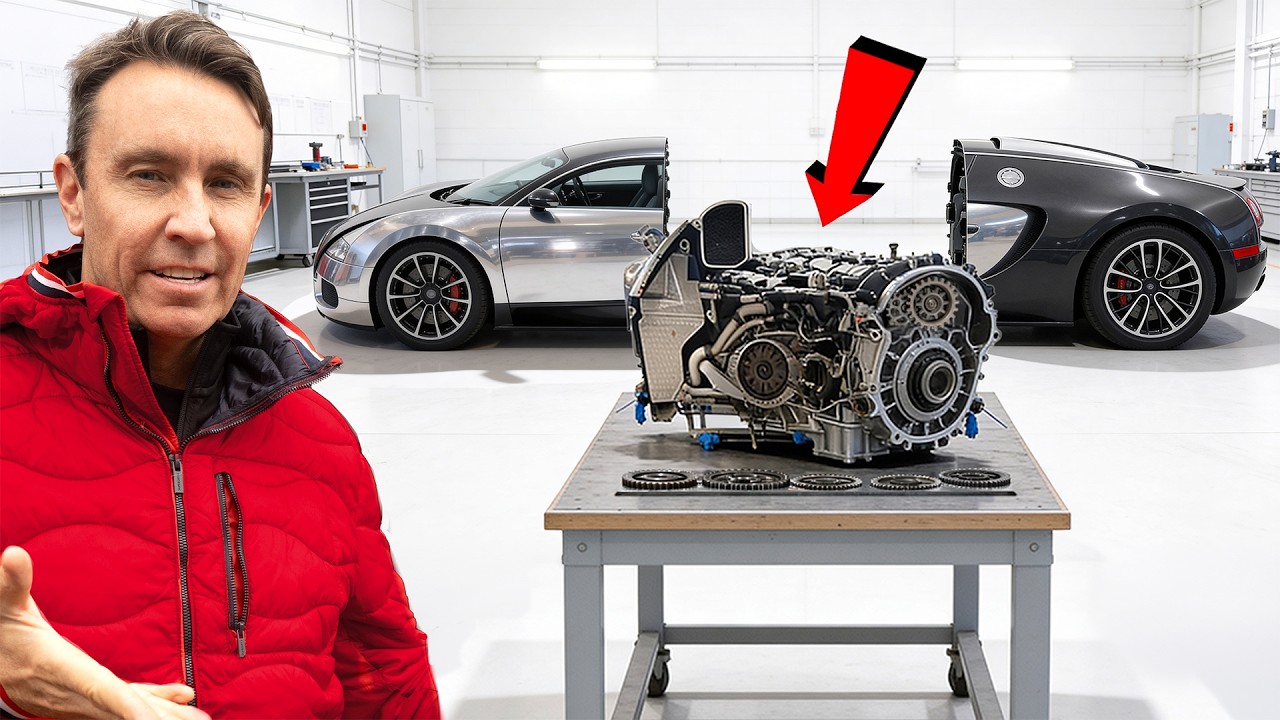

Bugatti nightmare: Mark McCann and his battle with the "unrepairable" gearbox
YouTuber Mark McCann from England has become the owner of one of the most expensive and "ugly" problems in the automotive world - a broken Mansory performance modified Bugatti Veyron. He bought the car for around £900,000, well below its market value of around £1.5 million, making it a high-risk project with a big potential profit.
Why he got the Veyron in the first place
Mark explains that the Bugatti Veyron's market value has risen significantly in recent times, but most of the cars available cost well above £1.5 million. When an offer came in for a Veyron at around half the market price, he didn't sleep on it.
But the car wasn't just cheaper - it was essentially split into two parts, the engine and the chassis, and it had a major problem: the gearbox was not repairable in a conventional way.
What is the fundamental problem?
The central issue is that Mark actually buys the Veyron as a "terminally ill" car. His colleague, whom he describes as "the wisest man in the car world", warns him directly that he has in fact acquired what is essentially a development project that is dependent on the successful repair of the gearbox.
The basic gearbox is a manufacturing marvel of Anglo-French collaboration: its development was led by British firm Ricardo, which created a seven-speed dual-clutch transmission (DCT) capable of carrying 1,000 horsepower daily and repeatedly, which is F1-level.
Why the gearbox is so problematic
The fundamental problem with the Bugatti Veyron is that there is virtually only one place in the world that has a test bed for this transmission - the manufacturer Ricardo.
This means if the gearbox is fixed "hot" it has to be in the car, and if after fitting it turns out that something is still wrong, the whole replacement process has to be repeated, which means high costs and time wasted.
What happened to the gearbox before
Mark describes that the initial problem is a material one: the manufacturer used an aluminium gearbox cover and a steel oil reservoir cap. These two materials, in the presence of water and salt, can cause what is known as galvanic corrosion, whereby the bolts come together so much that they usually unscrew.
Apparently, the bolt was drilled out during a previous oil change, and in the process, small metal chips (swarf) were formed that may have entered the transmission - a significant defect.
Which is an even bigger problem to fix
Mark points out that it's not one single thing in the gearbox, but dozens of components that can cause a problem.
Most of these are in the hydraulic system - selector branches, hydraulic paths, sensors and electronics - and their malfunction can only be reliably detected in real-world operation when everything is already in the car.
This makes the project considerably more complicated and costly than it looks at first glance, for the reasons mentioned above.
Comments
No comments yet. Be the first to join the discussion.