
America and Israel have struck Iran. Khamenei dead, Hormuz on edge and the Middle East in shock
How the war started: the first day of the operation
CzechCloud's stream summarises the first day of the new war, which escalated into an open armed clash between the US and Israel and Iran on Saturday morning.
According to him and his colleagues, the available information shows:
- this morning at around 7:30 our time, the Israeli Defense Forces (IDF) along with the US attacked Iranian targets, mainly in Tehran and other parts of the country,
- The attack was to target "strategic targets" - air defences, missile launchers and key regime figures,
- In the first hours of the operation, according to Israeli sources (and agencies quoted in the Czech media), the Iranian defence minister and also the commander of the Islamic Revolutionary Guards Corps, General Mohammad Pakpour, was killed,
- Iran responded with volleys of rockets and drone attacks on Israel and on US bases in the region.
CzechCloud points out that the stream was produced on Saturday evening, while the situation is evolving virtually by the minute, and other major events may have occurred during the night. It also stresses that this is an annotated debate over available sources - not an official news report.
Iran's leadership crackdown: the death of Khamenei and an attack on the elite
One of the most explosive moments in the stream is the passage about the alleged killing of Iran's supreme spiritual leader, Ayatollah Ali Khamenei.
According to references to world agencies and Czech media (Reuters, CTK, Respekt, Forbes, etc.):
- an unnamed Israeli official said that Khamenei was killed in Israeli-US strikes,
- according to this source, his body was found,
- The information was subsequently confirmed by US President Donald Trump on his Truth Social network,
- Israeli Prime Minister Benjamin Netanyahu has publicly indicated that "signals" about Khamenei's death are growing.
At the same time, some media outlets pointed out that Iranian media had announced Khamenei's speech, which introduced some uncertainty into the information. At the moment of the stream, however, CzechCloud is working with the version that Khamenei is dead, according to Israeli and American sources, and that his body has been found.
Other hits according to the sources cited:
- Attack on compound linked to Khamenei - CzechCloud shows satellite images of the "before and after" showing extensive destruction of buildings on the compound,
- the attack on the home of former President Mahmoud Ahmadinejad,
- crackdowns on other senior regime figures and Revolutionary Guard leadership.
From Washington's and Jerusalem's point of view, according to the statements available, the aim is not just a 'punitive strike' but the weakening or even the fall of the current Iranian regime. One Israeli official is quoted as saying that the goal is to "create all the conditions for the fall of the Iranian regime" and to target the entire political and military leadership - "past, present and future."
CzechCloud adds that the removal of Khamenei does not in itself automatically mean regime change - just as the sudden death of Vladimir Putin would not automatically mean a democratic Russia. In Iran, a harder faction may take power, or - in an extreme case - the exiled Crown Prince Reza Pahlavi, who is being talked about in Western debates as the possible "face" of a post-Islamist Iran. But all this is speculation.
Massive air operations and attacks across Iran
CzechCloud relies on statements by the IDF and other sources that the attack on Iran is one of the largest air operations in Israel's history.
Parameters cited:
- Up to 200 fighter jets were to be deployed,
- dropping "hundreds of munitions" on some 500 targets,
- targets: anti-aircraft systems (e.g. SA-5 at Kermanshah), missile launchers, Revolutionary Guard bases, ports, radar and naval installations,
- attacks have been reported from dozens of locations across Iran - CzechCloud shows a map with hits scattered virtually across the country (Tehran, Tabriz, Zanjan province and others), but stresses that these are all reported hits and cannot all be independently verified at this time.
The US is also heavily involved in the operation:
- According to the quoted statement by Donald Trump, the US military has launched a "major combat operation" in Iran,
- Tomahawk missile launches are mentioned,
- US MQ-9 Reaper combat drones are operating over Iran,
- Patriot systems and other air defence assets are on alert in the region.
CzechCloud and its guests speculatively discuss the possible future deployment of heavy bombers (B-2 Spirit, B-1, B-52) against deeply buried facilities of Iran's nuclear program (Fordo, Isfahan). However, there is no clear confirmation of the deployment of these machines at the time of the stream - it is a commented scenario of what the "next round" of operations might look like.
Iran strikes back: drones, missiles and attacks on civilian targets in the Gulf
Iran, according to information summarized by CzechCloud:
- fired approximately 150 ballistic missiles towards Israel during the day,
- launched dozens of attack drones (Shahid type),
- also attacked US bases in Iraq and the Persian Gulf,
- hit targets in Bahrain, Qatar, Kuwait, the United Arab Emirates (Dubai, Abu Dhabi) and other countries.
Among the specific instances heard in the stream:
- Bahrain - Shahid hit a large radar site associated with the US Fifth Fleet. CzechCloud mentions an estimate that a cheap drone costing roughly tens of thousands of dollars took out a radar system worth hundreds of millions of dollars. Footage of the fire and the aftermath is emerging.
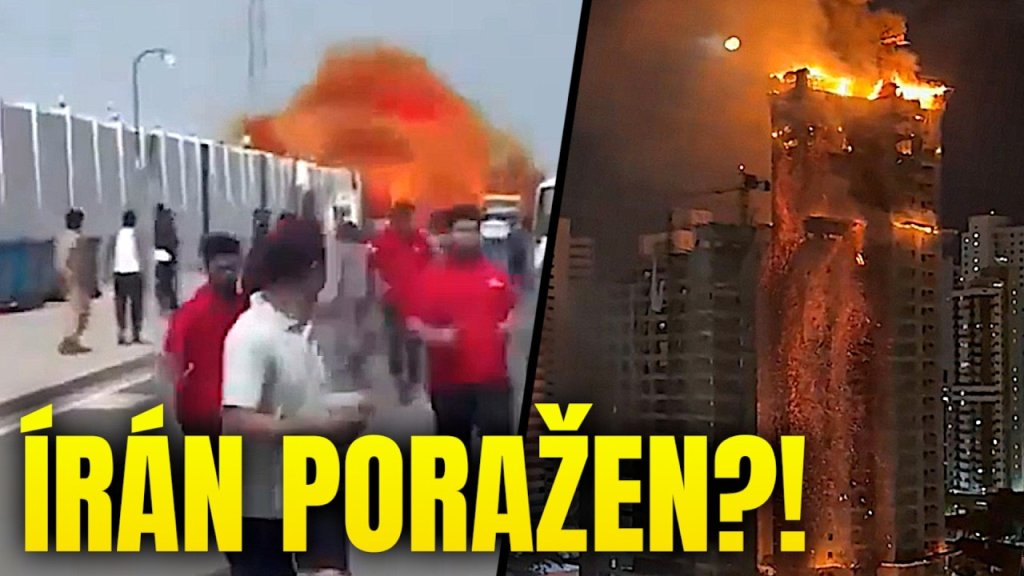
- Bahrain - residential house - footage shows the hit of a tall residential house (tower block), apparently a civilian building, at night with lights in the windows. CzechCloud likens this to Russian attacks on apartment blocks in Ukraine.
- Dubai and Abu Dhabi - videos show explosions and smoke near iconic neighborhoods, including man-made palm islands. One of the drones was supposed to fly near the Burj Khalifa skyscraper; however, available footage shows it missed it and hit other buildings.
- Katar - footage shows a downed missile carrier hitting the ground. Distinctive orange smoke hovers over the site; a guest warns that it may be hypergolic fuel, extremely toxic if inhaled and in contact with skin.
- Kuwait - According to AFP, the runway of an air base where Italian troops are also operating should have been extensively damaged. Footage shows a crater and a destroyed section of the airstrip.
Additionally, CzechCloud mentions Iranian Navy warnings towards vessels in the Persian Gulf, including reports of attacks on US support ships. This information could not be independently verified at the time of the stream.
Even more serious, he says, is the fact that Iran is attacking countries that were not directly involved in the US/Israeli attacks - particularly tourist and commercial hubs like Dubai and Abu Dhabi. In doing so, according to CzechCloud, Tehran is "burning any goodwill" it may still have had in the region.
World reaction: condemnation of Iran, Gulf caution and the shadow of the Strait of Hormuz
Gulf Arab states against Iran
CzechCloud reads and comments on official statements from Middle Eastern countries today:
- United Arab Emirates - says Iranian attacks violated its sovereignty and reserves the right to respond.
- Qatar - Foreign Ministry "strongly disagrees" and also reserves the right to respond.
- Kuwait - condemns the "sinful Iranian attack" targeting its territory.
- Saudi Arabia - describes Iranian attacks on the Emirates, Bahrain, Qatar, Kuwait and Jordan as a threat to regional security and calls on the international community to condemn Tehran.
- Jordan - Iran has attacked Jordanian territory "without any justification", according to its foreign ministry.
Taken together, these statements show that Iran's actions against civilian and military targets in the Gulf have created a broad coalition of disaffected and even openly hostile states in the region.
Russia, China and the West
On the other side stands the reaction of the great powers:
- Russia - according to the Russian Foreign Ministry, this was a "reckless armed aggression" by the US and Israel against Iran that was "unprovoked". Former President Dmitry Medvedev then, in a typically pointed comment, contrasts the "young" US and the "2500-year-old Persian Empire", saying that only time will tell who survives.
- China - calls for an immediate halt to military action in the Middle East and for de-escalation.
- Europe and allies - Germany, France and Britain declare commitment to "regional stability" and protection of civilians, French President Emmanuel Macron calls for a UN Security Council meeting and pressure on Iran to end its nuclear and ballistic missile programmes. Canada expresses support for the US in preventing Iran from obtaining a nuclear weapon.
- Czech Republic - Andrej Babiš (ex-Prime Minister) on social media "totally condemns" Iran's attacks on Qatar, Kuwait, UAE, Bahrain, Saudi Arabia and Jordan, calling them an unacceptable violation of the sovereignty of countries that did not participate in operations against Iran.
Strait of Hormuz: the "nuclear button" for oil
The crucial economic dimension of the conflict is illustrated by the situation in the Strait of Hormuz - a key chokepoint for world oil trade:
- According to reports cited by CzechCloud, several major oil companies and trading houses have suspended shipments of oil and fuel across the strait,
- Vessels are reporting broadcasts from Iran's Revolutionary Guards that "no ships are sailing" - Iran is threatening a de facto blockade,
- satellite images and traffic maps show that some tankers are holding back and waiting outside the most difficult part of the strait,
- the US command has already warned of the security risks of the canal and is looking for a way to provide escorts and protection for commercial shipping, according to CzechCloud.
Guests on the stream note that while Saudi Arabia does have a pipeline bypassing Hormuz, it falls far short of the volumes that flow through the Persian Gulf today. Closing the strait for weeks or months would mean
- a sharp rise in oil and fuel prices,
- pressure on the world economy,
- a direct impact on the Czech Republic, even though the country has strategic oil reserves of only a few weeks or so.
CzechCloud sums up the situation by saying that the conflict is now "at a 9.9 out of 10 level" and that the closure of Hormuz is "the equivalent of a nuclear button" for Iran - a tool to damage the West and the region, even at the cost of its own disaster.
Czechs in the region and the daily reality of war
The Czech dimension is also heard in the stream:
- According to an interview with Czech diplomatic representatives (quoted in Seznam Zprav articles), there are only a few Czech citizens in Iran itself, but "thousands" in the wider Middle East,
- the foreign minister (identified as Petr Macinka in the context of the website, but this is a satirical or misstated figure; the real minister at the time of the conflict is Jan Lipavsky) strongly advises against travel to the Middle East and warns of a "massive operation" lasting weeks,
- Czech authorities are reportedly trying to get compatriots out of risky areas in time, but not all have managed to evacuate before fighting breaks out.
At the same time, CzechCloud adds a personal dimension: it mentions that the Czech streamer Fitman was supposed to be in Dubai at the time the missiles were landing in the area. According to his words, one rocket exploded about 700 meters from the accommodation, which illustrates how closely the tourist and "influencer" reality meets the war reality.
In Israel itself, he shows footage of people in shelters, trying to cope with the situation even while singing. In Iranian cities, on the other hand, direct images from the ground are missing due to the internet being shut down - information comes in snippets, often only in the form of reports of explosions and missile impacts.
An extremely uncertain future: regime collapse, protests and a long war
CzechCloud returns to the fundamental question at the end of the stream: what's next.
Key open points include:
- Confirmation of Khamenei's death - if the Supreme Leader is definitively proven dead, it will be the biggest change in Iran in decades. But so far there is a discrepancy between the claims of Israeli/US officials and Iranian official statements.
- ** Succession** - it is not clear who will take power. It could be a more radical section of the regime, a compromising religious elite, or - in an extreme scenario - the return of exiled Prince Reza Pahlavi if an internal coup succeeds.
- The Role of the Iranian Public - guests recall the protests of recent years (especially after the killing of Mahsa Amini) and the brutality of the security forces (shooting demonstrators, including children). Iranians have "had decades to change" but the regime is repressive and armed. Thus, even according to CzechCloud, the success of the Western "regime change" operation ultimately depends on the Iranians themselves - whether they will be able and willing to rise up to mass protests at the very moment when missiles are flying through the cities.
- The length and scale of the operation - according to military commentary cited by CzechCloud, this could be a several-day to several-week campaign with "waves" of attacks every day. At this point, it is "only" the first day with permanent explosions on both sides.
At the same time, he reminds us that the conflict with Iran is taking place on a completely different level from earlier episodes in the Middle East - and that the intensity of the air strikes "is unprecedented even at the start of the war in Ukraine".
Summary: a war that could redraw the Middle East
From the information that CzechCloud and its team piece together in real time, a picture of an extremely serious crisis emerges:
- The US and Israel have launched a coordinated air campaign against Iran, targeting air defences, missile forces and the regime leadership itself.
- According to Israeli and US sources, the supreme spiritual leader Ali Khamenei has been killed, as have other top regime figures, including the defence minister and the commander of the Revolutionary Guards. The Iranian side has not officially confirmed this.
- Iran is responding with missiles and drones not only to Israel and US bases, but also to the Gulf States, including civilian neighbourhoods in Dubai and Bahrain, creating a wide range of regional enemies.
- The Strait of Hormuz is under a de facto blockade, with some tankers having stopped sailing. This risks a sharp rise in oil prices and a global economic shock.
- The world is divided in its assessment of the causes: the West speaks of the need to stop Iran's nuclear and missile programme, Russia and its allies describe the attack as unprovoked aggression.
- For the Czech Republic, the conflict is relevant not only because of oil and the world economy, but also because of its compatriots in the region and the changing security environment in Europe.
CzechCloud continuously stresses that this is a quick update in time of an ongoing operation, not a definitive picture. Key facts - including Khamenei's death, the extent of civilian casualties in Iran, and the impact of the Hormuz blockade - will be confirmed or refuted in the days ahead.
Comments
No comments yet. Be the first to join the discussion.