
America and Israel attack Iran: what we know, what is propaganda and who stands to gain
How the operation began and what was said in Trump's speech
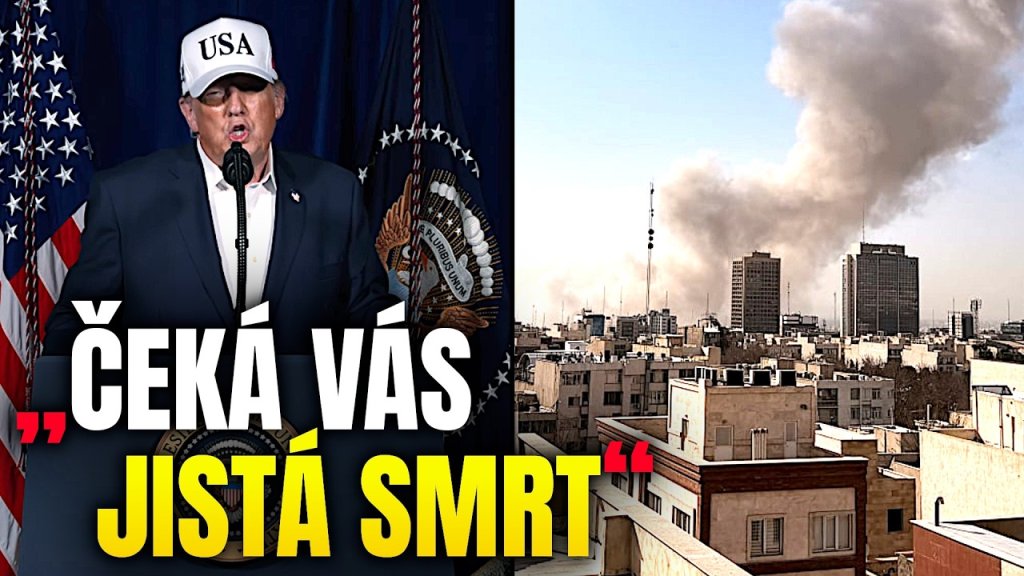
On Saturday morning, US President Donald Trump confirmed the launch of a large-scale combat operation against Iran. In the speech, which according to CzechCloud was pre-recorded and apparently long in the making, Trump spoke of a "major combat operation in Iran" and repeated several times that the goal is to prevent Iran from obtaining a nuclear weapon.
Key points from the speech, which CzechCloud and its guests replayed and continuously commented on:
- US and Israel have launched a joint operation, Trump talks of a "large-scale and massive operation".
- The official pretext: eliminating the "imminent threat" and stopping Iran's nuclear program.
- Iran is described as a "state sponsor of terrorism" and a "brutal regime".
- Trump openly admits that he is counting on the possible loss of American soldiers' lives.
- He concludes by appealing to Iranians to "take their destiny into their own hands" - a call for regime change, not the destruction of a nation.
CzechCloud adds that the speech is clearly war propaganda, but at the same time understands the West's motivation to have "an Iran without a nuclear weapon rather than with one." It reminds, however, that the official reasons and the actual strategic goal may differ.
Targets of attacks: regime command, military infrastructure, possibly nuclear programme
According to the information available, which CzechCloud discusses with guests and which they draw from Israeli and Western media, the operation primarily targets:
- high officials of the Iranian regime (the so-called "strongmen"), including the military leadership,
- command and staff structures in Tehran and other cities,
- military bases and infrastructure including naval bases in the Persian Gulf and Arabian Sea,
- **air defence (air defence) ** - some of which, they say, were already significantly weakened in the earlier Operation Midnight Hammer a year and three months ago,
- potentially sites related to the nuclear programme (Esfahan, Natanz), although the detailed status of the programme is unknown outside official sources.
It is reported that:
- the current wave of strikes mainly uses cruise missiles against command and "time sensitive" targets,
- to pave the way for possible heavier bombing at night,
- the strikes are not formally a "declaration of war" - the US would need congressional approval for this, so there is talk of a "special military operation" with no time limit.
CzechCloud and guests point out that:
- we don't know whether the real strategic goal is just the nuclear program or also regime change,
- unconfirmed reports of the killing of Defence Minister Amir Hatami and other senior figures should be taken with a grain of salt - they were not independently verified at the time of the stream.
Phase one: explosions in Tehran, internet blackout and airstrikes spreading
The footage, which CzechCloud replays and comments on the stream, shows:
- explosions in Tehran and other parts of Iran, including areas near the seats of the military and political leadership,
- missiles over the border** (video from Iraq - missiles flying towards Iran, probably from the first waves of the attack),
- Tomahawk cruise missiles over Tehran.
At the same time, information is coming in about a massive hit on Iran's infrastructure:
- network data shows almost complete internet outage across the country, connectivity at about 4% of normal,
- CzechCloud and its guests interpret this as deliberate internet shutdown mode, not an accidental outage.
It further reads:
- some of the air defense systems around Tehran should have been significantly damaged in the previous operation,
- it is unclear to what extent Iran has managed to rebuild its defences in the meantime,
- the fact that the US and Israel are attacking in the daytime is commented on as a sign of great confidence in the destruction of Iran's air defences.
Iranian response: missiles on Israel and US bases in the Persian Gulf
Very quickly after the launch of the operation, reports of counter-attacks from Iran and its allies came in:
- radio and siren alerts throughout almost all of Israel, thousands of alerts in a short period of time,
- launches of ballistic missiles from Iran into Israel - in the order of units to tens of units, according to Israeli sources, not hundreds as in the major attack last year,
- along with attacks by Hezbollah from the north on Israeli territory.
According to what CzechCloud and its guests are continuously monitoring:
- Israel's Iron Dome intercepts most of these missiles,
- even so, at least some impacts on Israeli territory are reported (without detailed location),
- there have also been attacks on US bases and targets in the Gulf:
- Bahrain (hit in an area where a US base is located),
- United Arab Emirates (Abu Dhabi, Dubai - explosions including the port area),
- Qatar (shooting down an Iranian missile with the Patriot system),
- Kuwait and Jordan (reported explosions near US positions).
The Iranian Revolutionary Guard publishes a statement in which:
- Confirms attacks on US bases in Kuwait, Bahrain and the UAE,
- describes the US-Israeli airstrikes as a "brutal attack on the brave Iranian nation",
- says it is launching a "decisive response" and will keep the public informed,
- calls on Iranians to remain calm, restrict movement, leave potentially threatened areas,
- announces the closure of schools and universities, partial (50%) operation of offices and assures that the supply of basic goods is assured.
CzechCloud and guests point out that this is official state communication from Iran, i.e. propaganda from the other side, and is therefore treated with caution.
Regional and global context: oil, Middle East and China in the background
CzechCloud repeatedly reminds that the conflict cannot be seen in isolation. Three fundamental levels emerge in the debate:
1. Oil and the Strait of Hormuz
- The key point is the Strait of Hormuz, through which a large part of the world's oil exports flow.
- There have been reports of attacks on Iranian naval bases in the Persian Gulf and Arabian Sea, which would make sense as a precaution against an Iranian attempt to block the Strait.
- Some cargo companies, according to guests, are already rerouting along Africa to avoid the risk in the Red Sea and Persian Gulf.
- The debate sounds a scenario:
- short-term sharp rise in oil prices,
- a long-term possible price drop if Iran as a major producer drops out or loses the ability to use oil as a political weapon.
2. Attitudes and capacities of neighbouring states
The guests discuss whether other states in the region could be involved in direct attacks on Iran:
- Saudi Arabia, the United Arab Emirates or other Gulf countries have American or European technology (modern fighter jets, air defence),
- they have the military capability, but so far the political will to go into open conflict with Iran has been lacking - fears of regional war and the impact on trade and oil exports,
- speculation that Iranian attacks on US bases on their territory may be seen as a violation of sovereignty and may change their position,
- at one point, it is suggested that the UAE is considering retaining the right to its own response - but at the time of the stream, there is no official confirmation of this.
3. China as the "third laughing stock"
One of the most interesting parts of the discussion concerns the long-term implications for the balance of power:
- Guests point out that every other major conflict where the US is militarily depleted (materiel, munitions, navy, air force) relatively strengthens China,
- The US, they say, no longer has the excess capacity it had during Operation Desert Storm,
- the U.S. Navy is:
- Overstretched by long-term deployments (aircraft carriers are spending far more time at sea than they should),
- suffering from a shortage of new ships (cancelled or troubled destroyer and frigate programmes),
- some new ship classes have been politically driven but technically problematic,
- China, they say, is watching closely:
- How F-22 and F-35 stealth fighters are deployed in real combat,
- how quickly US munitions and naval capabilities are being used up.
CzechCloud and guests summarize that every greater US and Israeli exhaustion in the region opens up space for China, which will not go into the conflict itself, but is gathering data and strengthening its relative position.
Uncertainties, propaganda and the "third world" question
Much of the discussion is devoted to what we don't know and how to work with the propaganda of both sides:
- Many "guaranteed" reports (killing of specific Iranian officials, exact locations of strikes) are unverified at the time of the stream and often come from accounts with a clear agenda,
- videos of explosions are disseminated in massive volume, but locations and time are not always clear,
- CzechCloud repeatedly warns that:
- information is attempted to be verified from multiple sources,
- the stream is "a debate with our perspectives, not a guaranteed fact sheet".
When asked if this is all heading towards World War III, several important points are made:
- none of the key players have a clear interest in open global war - the costs would be extreme,
- current operations (Ukraine, attack on Iran) are conducted as limited conflicts with specific objectives, although they can escalate unpredictably,
- WW3 would probably look like a series of linked regional conflicts, not necessarily a single "front line" as in the last century,
- the extreme economic interdependence (China-West, energy, technology, drugs, chips) greatly increases the pressure to refrain from all-out conflict.
CzechCloud adds that if anyone really wanted to deliberately start WWIII, they would very likely face massive rejection even from formal allies and huge geopolitical risk. This is one reason why even very sharp operations are formally framed as "limited".
Final Summary
From what CzechCloud and his team observed and commented on during the live broadcast, several sobering conclusions can be drawn at this point:
- the US and Israel are conducting a coordinated, planned operation against Iran, with the stated goal of eliminating the "imminent threat" and preventing it from acquiring a nuclear weapon.
- In practice, however, the strikes also target the regime's command structures and infrastructure - i.e. Iran's ability to wage war and run the state.
- Iran responds with missile attacks on Israel and US bases in the Persian Gulf, some of which are intercepted by air defense missiles, some of which reportedly land.
- The situation is very dynamic, the volume of information and misinformation is enormous, as CzechCloud openly admits during the broadcast.
- From a global perspective, the long-term depletion of the US and Israel in regions like the Middle East can relatively empower China, which is watching the conflict from afar.
- A direct path to World War III is not obvious from today's events, but the risk of further regional escalation and deeper division of the world into blocs is growing.
CzechCloud holds two lines throughout the stream: on the one hand, he openly says he prefers a world where Iran does not have a nuclear weapon; on the other hand, he points out the propagandistic nature of both sides, the possible role of raw materials (oil), and the long-term implications for the West - especially in the context of competition with China.
Comments
No comments yet. Be the first to join the discussion.