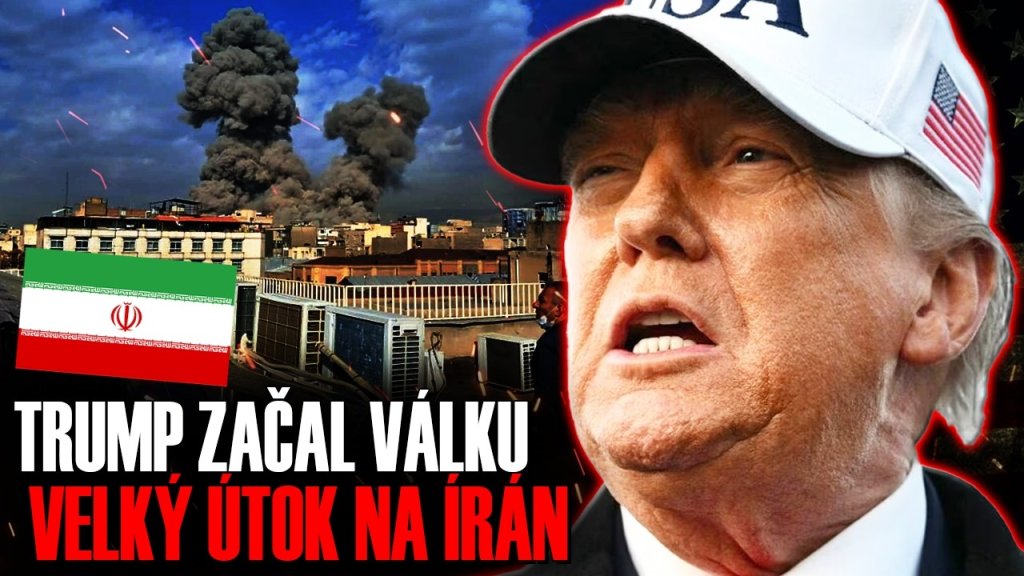

A massive US strike on Iran: dismantling its nuclear programme or a dangerous game of civil war?
From "schooling" to Operation Epic Fury
Lukas Nosek on The Lukas IV Channel describes how the US and Israeli attacks on Iran have moved from limited airstrikes to a massive operation.
Earlier actions, such as operations with codenames like Twinning Lion or Midnight Hammer, had these characteristics, he says:
- They were short-term and relatively limited interventions,
- there were not many forces deployed (Israel itself does not have such a capability, the US did not use it to its full potential at the time),
- the aim was primarily to weaken air defences and delay Iran's nuclear programme,
- the attacks targeted uranium storage facilities and other facilities.
Nosek points out that destroying uranium storage facilities alone is of limited military effectiveness. Uranium is a metal - it breaks, it gets damaged, some of it melts, but it remains essentially usable. By this logic, Iran can:
- Secure the area,
- use metal detectors and radiation to collect the material again,
- and resume the nuclear programme after a while (albeit with damaged centrifuges and technology).
Thus, according to Nosek, these raids did not lead to the destruction of the program or the overthrow of the regime, but had other effects:
- de-legitimized the regime in the eyes of some of the population,
- showed that the Iranian leadership was incapable of effectively defending the country,
- gave the people "hope" that the regime might not be indestructible.
Epic Fury: The Massive Rise of American Power
According to Lukáš Nosek, the current operation Epic Fury is fundamentally different in scope and ambition.
The aforementioned features of the current intervention:
- It involves two aircraft carriers and hundreds of aircraft,
- it is an extremely expensive operation costing millions of dollars,
- the scale is much larger than previous operations.
The stated goal this time is
- to "decapitate" Iran's nuclear program, i.e., to deal it a blow that would render it unable to continue in its current form,
- according to US statements and Donald Trump's rhetoric, and "overthrowing the regime ".
But it is the latter point that Nosek identifies as potential propaganda:
- talking about Iranian freedom, regime brutality, executions, oppression of women, and support for terrorism is an effective way to garner public support for the attack,
- but in reality, the primary and only real goal may be to destroy the nuclear program,
- "regime overthrow" may be too risky from a security and geopolitical perspective and may not be one of the actual intended outcomes.
Nosek thus distinguishes between what is said to the public and what may be the real strategic goal - and considers the destruction of nuclear capabilities, not the deliberate inducement of regime collapse, to be the key goal.
Oil, Hormuz and Moscow: the first wave of repercussions
One of the most immediate effects of the conflict, according to Lukáš Nosek, is what is happening around the Hormuz Strait and the price of oil.
Possible steps by Iran:
- closing the Strait of Hormuz - one of the most important energy hubs in the world,
- attacks on targets in the Persian Gulf (Bahrain, Abu Dhabi and other places),
- creating instability in the region, where much of the world's oil supply flows.
Expected impacts on oil according to Nosek:
- A short-term shock could see prices rise by as much as 40%,
- once the situation calms down and more rational trading takes hold, the effect could be around 15%**,
- but even a 15% rise is significant: it will make fuel more expensive and will be reflected in the economies.
At the same time, Nosek points to the greater impact on Russia:
- High world oil prices benefit Moscow,
- Russia's budget, he says, is "bleeding" because of low Urals oil prices,
- the rise in world prices is pushing up the price of Russian oil, although it may be partially limited by sanctions,
- this means more money for the Russian regime and an unpleasant signal for Ukraine and Europe, as Russia may intensify its financing of the war.
Lukas Nosek also notes that the attack was timed for weekend when markets are closed. According to him, this was Donald Trump's intention:
- To avoid an immediate price shock,
- to give the markets time to react on Monday with more information and less panic.
Missiles, drones and Ramadan: the Iranian response
According to Nosek, Iran is responding with a combination of military and psychological steps.
Rockets and drones
Iran has thousands of missiles and drones. These are aimed at:
- on American bases,
- on Israel,
- other targets in the region.
The balance sheet so far, as Nosek describes it:
- there are reports of explosions, smoke columns, object hits,
- damage is being inflicted, but there are no effective strikes yet to stop the American offensive,
- the attacks are raising tensions and adding to the uncertainty.
The symbolism of Ramadan
Moreover, the conflict is taking place during Ramadan, which has an impact on the perception of the situation in the Muslim world:
- attacks during religious holidays annoy part of the population in the region,
- according to Nosek, it "pisses off" local US allies because they feel their holidays are being disrupted,
- which is why he himself expected the attack to occur after Ramadan - around mid to late March - but in the end there was no such delay.
Insurgency, civil war and nuclear material
A crucial part of Lukáš Nosek's commentary is devoted to the question of what a real overthrow of the regime in Iran would mean and what risks are involved.
Challenges to the uprising
From exile come calls for Iranians to take control of their country. Nosek mentions, for example:
- Pahlavi's statement from the United States calling on Iranians to take advantage of the US attacks and rise up against the regime.
But Nosek says much depends on the mood of Iranian society after previous protests, which were harshly suppressed:
- if fear prevails, people may perceive the US attacks more as interference and fearfully move around the regime,
- if anger and frustration prevail, some segments of the population may lean towards open resistance.
He warns that frightened people tend to react submissively - he likens this to a section of Czech society which, under pressure of fear, calls for retreat to the aggressor (in analogy to Russia and Ukraine).
Risks of civil war
Iran is not a homogeneous state. Nosek recalls several key points:
- The northern regions in particular have the potential for separatist tendencies - for example, among Azeris, Kurds or other ethnic groups,
- Iraq is in the neighbourhood, where various armed groups persist despite some stabilisation,
- in addition, there is Afghanistan under Taliban rule.
If there were a mass uprising and parts of the army opposed to the regime, there could be a civil war in Iran. The implications Nosek points out:
- radicalism and separatism would flare up in the country,
- creating a breeding ground for new terrorist structures with a possible reach to the West,
- a key risk: access to radioactive materials.
Iran has:
- ** uranium enrichment facilities**,
- stockpiles of radioactive material,
- potentially infrastructure that could be used to create weapons-grade material.
In the chaos of a civil war, Nosek said, these stockpiles could be accessed:
- terrorists,
- radical armed factions,
- or groups linked to the Taliban in Afghanistan.
The danger lies not only in a full-fledged nuclear weapon, but also in its use as a "dirty bomb ":
- a large quantity of highly radioactive material is sufficient,
- which can be dispersed over a large area with a conventional bomb,
- the consequences for the civilian population and the psychological effect would be considerable.
This is why Lukáš Nosek considers it unlikely that the United States would consciously pursue a scenario that leads to a large-scale civil war in Iran. Destabilization of the country on such a scale, in his view, poses "too great a security risk " - even for the West itself.
The Czech point of view and the question of what we actually want
Nosek concludes by touching on Czech politics and the broader debate about what goals the West should pursue.
He mentions that:
- according to the Czech Prime Minister, Iran is a threat that must be got rid of,
- The Czech Republic takes the side of the United States in its actions towards Tehran,
- at the same time, the Czech Republic has three of its citizens in Iran, but according to available statements does not plan special rescue action for them.
Nosek also recalls the experience with the arguments about weapons of mass destruction in past conflicts - whether nuclear or chemical - and suggests that the type of "excuse" may differ, but the mechanism is similar.
His main message to the Czech viewer is twofold:
- it is not certain that massive bombing will lead to the overthrow of the regime in Iran - this is far from a guaranteed outcome,
- the destabilisation of Iran may bring even worse scenarios than the current oppressive leadership - including the risk of dirty bombs and the export of terrorism.
Nosek therefore stresses the need for everyone to be clear about what goal the West should actually want to achieve and what level of risk it is willing to accept.
Final Summary
In a video on The Lukas IV Channel, Lukas Nosek discusses the massive US strike on Iran as an intervention that differs significantly from earlier limited operations. In his view, Operation Epic Fury is realistically intended primarily to destroy Iran's nuclear program, while the rhetoric about toppling the regime may be largely propaganda framing for domestic and international audiences.
At the same time, however, he warns that any move towards civil war in Iran poses high security risks: from rising oil prices and a strengthening Russia, to widespread instability in the region, to the possibility of radioactive material falling into the hands of terrorists. In this light, the question of "destroy the regime at any cost" becomes a far more complex dilemma, in which it is not certain that the collapse of the current theocracy automatically means a safer world.
Comments
No comments yet. Be the first to join the discussion.